Quick Summary
Two homeowners in the Temecula Valley can receive very different trenchless sewer repair estimates, even when their sewer lines appear to have similar problems. The difference often comes down to the length and depth of the pipe, the type and extent of damage, access to the sewer line, and whether pipe lining, pipe bursting, or excavation is needed. Driveways, patios, landscaping, and other obstacles can also affect the work involved. A sewer camera inspection helps identify the actual problem so the repair can be planned around the condition of the pipe rather than assumptions.
- Pipe length and depth: Longer or deeper sewer lines may require more materials, labor, equipment, and excavation.
- Access and restoration: Cleanout locations, driveways, patios, and landscaping can affect the scope of work.
- Repair method: Pipe lining, pipe bursting, and traditional excavation involve different equipment and installation requirements.
- Pipe condition: Root intrusion, cracks, corrosion, offsets, and collapsed sections can change which repairs are possible.
- Inspection and estimate details: Understanding what is included in a quote helps homeowners compare their options.
- Sewer lateral responsibility: The local sewer provider’s rules may affect repair responsibility, particularly near streets and public rights-of-way.
How Line Length and Pipe Depth Affect Trenchless Sewer Repair Cost
One of the biggest factors in a trenchless sewer repair estimate is how much pipe needs to be repaired or replaced. A short damaged section near the house presents a different job than a longer sewer lateral running beneath a driveway, across a yard, or toward the street.
With pipe lining, a longer repair may require more liner material, additional cleaning and preparation, and more installation time. With pipe bursting, the length of the replacement affects the amount of new pipe, the installation process, and the equipment needed to pull it into position.
However, sewer repair pricing is not simply a matter of multiplying the pipe length by a fixed cost per foot. Equipment setup, pipe preparation, access, and restoration all contribute to the work. A short repair with difficult access can sometimes involve more labor than a longer repair with straightforward conditions.
If you want to understand the available repair methods, our trenchless sewer repair and relining services page explains how we approach damaged sewer lines without requiring a continuous trench in many situations.
Why the Depth of Your Sewer Line Matters
Trenchless repair reduces the need to excavate the entire sewer line, but it does not necessarily eliminate digging. Depending on the repair method, the crew may need access pits or other entry points to reach the damaged section.
A sewer line buried several feet below the surface may require more excavation than one closer to ground level. Soil conditions, nearby utilities, access restrictions, and the equipment needed to work at that depth can also affect the job.
For homeowners in Temecula, Murrieta, Lake Elsinore, Menifee, Wildomar, and surrounding communities, the location and depth of a sewer line can vary significantly by property. The home’s age, lot layout, elevation, and original plumbing installation all matter.
That is why determining the line’s location and depth is an important part of evaluating the repair rather than assuming two nearby homes will require similar work.
Why Sewer Line Access and Cleanout Location Change the Estimate
A sewer cleanout is an access point that allows a plumber to inspect, clear, and service the sewer line. When the cleanout is accessible and positioned appropriately, it can simplify the work needed to diagnose and prepare the pipe.
When a cleanout is missing, buried, damaged, or located where it does not provide suitable access for the proposed repair, additional work may be needed. The crew may need to establish another access point or excavate a section of the pipe.
If you are unsure where your cleanout is located, our article on finding and understanding your sewer cleanout explains where to look and why accessibility matters.
Driveways, Patios, and Landscaping Can Increase the Work
The ground above a sewer line can have a major impact on the repair process. A pipe running beneath an open lawn is often easier to access than one beneath concrete, pavers, retaining walls, or established landscaping.
For example, imagine two homes with sewer lines of similar length and depth. One line passes through an open side yard. The other runs beneath a stamped concrete patio and mature landscaping. Even if the damage is similar, the second property may require more planning, equipment, and surface restoration.
One advantage of trenchless sewer repair is that it can reduce the amount of excavation needed. However, minimizing digging does not always mean eliminating it entirely.
A complete estimate should explain whether access pits, concrete removal, landscape restoration, or other property-related work is included. These details can make a substantial difference when comparing two proposals.
How Pipe Condition and Root Damage Affect Repair Costs
The condition of the existing sewer line often determines which repair methods are practical. A pipe with minor cracks or root intrusion presents a different challenge from one with severe corrosion, displaced joints, an incorrect slope, or a collapsed section.
Some damaged sewer pipes can be rehabilitated with a liner. Others may need replacement using pipe bursting or conventional excavation. The appropriate method depends on whether the existing pipe can support the proposed repair and whether the installation will correct the underlying problem.
For example, a sewer line with roots entering through damaged joints may be a candidate for lining if the pipe has suitable structural conditions and the roots can be removed. A severely collapsed section may prevent liner installation or require excavation before another repair method can be used.
A sagging section of pipe, often called a belly, presents another issue. Water and debris can collect in the low area, contributing to repeated blockages. Installing a liner does not automatically correct the slope of the existing pipe. If the grade needs to be changed, excavation or another corrective approach may be necessary.
Why Clearing Tree Roots May Not Solve the Underlying Problem
Tree roots can enter sewer lines through cracks, openings, and deteriorated joints. Once inside, they can trap debris and restrict wastewater flow.
Mechanical cleaning or hydro jetting may restore drainage by removing roots and buildup. However, cleaning does not necessarily repair the opening that allowed the roots to enter. If the defect remains, the intrusion may return.
Our article on tree roots in sewer lines in Temecula Valley homes explains the warning signs and available repair approaches.
When a pipe has recurring root intrusion, the repair decision should address both the obstruction and the condition of the pipe itself. Depending on the findings, a lasting repair may involve lining, pipe bursting, or replacement of the affected section.
Repeatedly clearing the same blockage without understanding why it returns can make it harder for homeowners to evaluate whether ongoing maintenance or a more comprehensive repair is the better option.
How Pipe Lining vs. Pipe Bursting Changes the Cost
Trenchless sewer repair is not a single procedure. Two common approaches are cured-in-place pipe lining and pipe bursting. Both can reduce excavation compared with traditional replacement, but they work differently and have different installation requirements.
Cured-in-Place Pipe Lining
Cured-in-place pipe lining, often called CIPP, involves installing a resin-saturated liner inside the existing sewer pipe. The liner is then cured to form a new pipe within the old one.
This approach can be effective when the existing pipe provides a suitable path for installation and its condition allows proper preparation and liner placement.
The work may include cleaning, removing roots or scale, inspecting the pipe, preparing the surface, installing the liner, and verifying the completed repair.
Costs are influenced by the length and diameter of the pipe, the preparation required, access, and the liner installation process.
Trenchless Pipe Bursting
Pipe bursting is a replacement method rather than a lining method. A bursting head is pulled through the existing sewer line, breaking or displacing the old pipe while a new pipe is pulled into place.
Pipe bursting may be considered when the existing pipe is too deteriorated for lining but the site conditions allow a new pipe to be installed along the existing route.
This method generally requires appropriate entry and exit access. The pipe material, surrounding utilities, soil conditions, available space, and the route of the existing sewer line all affect whether it is suitable.
The U.S. Environmental Protection Agency’s pipe bursting technology fact sheet provides technical background on the method and its applications.
When Traditional Excavation May Be Necessary
Not every damaged sewer line is a good candidate for trenchless repair. A severe belly, major pipe displacement, collapsed section, or other site limitation may require excavation to correct the problem.
Traditional excavation can involve removing and replacing an exposed section of pipe, correcting its slope, and restoring the surrounding area.
While trenchless methods can reduce property disruption, they are not automatically the least expensive or most appropriate choice for every situation. Comparing methods requires looking at the complete repair, including excavation, preparation, installation, and restoration.
Our sewer line repair and replacement services cover additional options when conventional repair or replacement is needed.
How a Sewer Camera Inspection Helps Define the Repair Scope
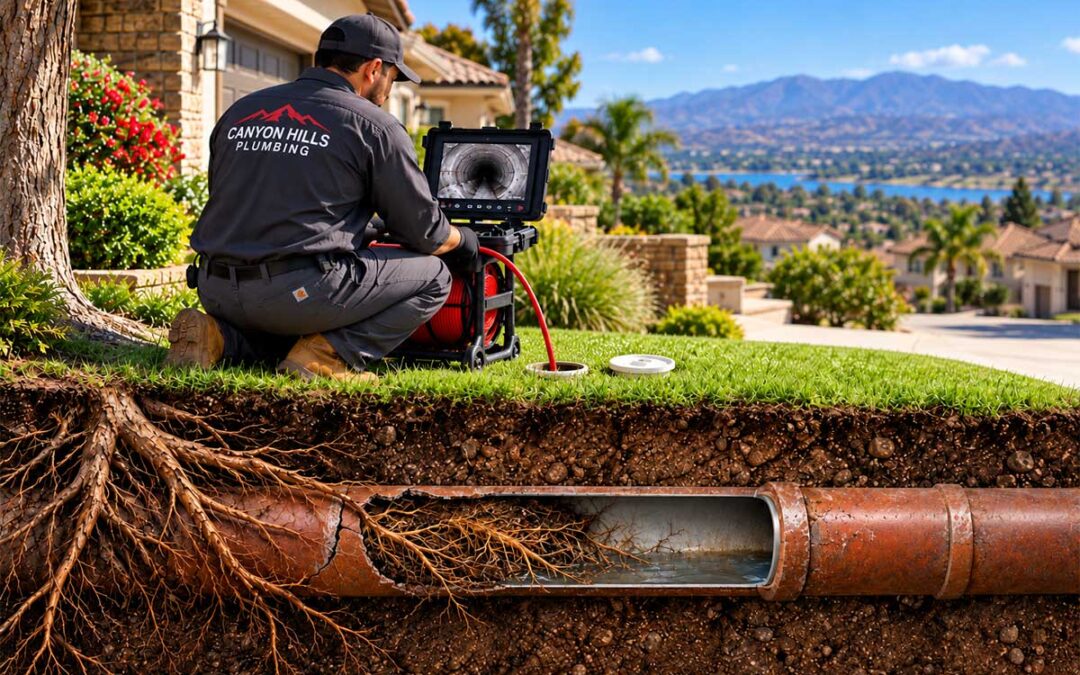
A sewer camera inspection is one of the most useful steps in evaluating an underground sewer problem. It allows a plumber to examine visible conditions inside the pipe and identify issues such as cracks, root intrusion, displaced joints, standing water, and buildup.
A camera system can also help measure the distance to an observed problem. When combined with compatible locating equipment and site measurements, the inspection can help establish where the pipe runs and how deep it is buried.
The camera itself does not reveal every underground condition. It cannot directly show everything happening outside the pipe, and heavy buildup or standing water may limit visibility. Even so, inspecting the line before selecting a repair method provides far more useful information than relying on symptoms alone.
At Canyon Hills Plumbing, sewer camera inspections help identify problems and guide repair recommendations.
Why the Extent of Damage Matters
Two estimates may differ because the contractors are proposing to repair different portions of the line.
One estimate might address a single damaged section. Another might recommend rehabilitating or replacing a longer section because the inspection identifies several defects.
Neither approach is automatically correct. The important question is whether the proposed work addresses the existing problem and the condition of the remaining pipe.
Our article on what a drain camera inspection reveals that snaking cannot explains why identifying the cause of recurring blockages matters.
A thorough evaluation reduces uncertainty, but it cannot guarantee that every hidden condition will be identified before work begins. Homeowners should understand how unexpected findings would be handled if the repair scope needs to change.
What Should Be Included in a Trenchless Sewer Repair Estimate?
If you are comparing estimates from two plumbing contractors, the total amount is only part of the comparison. You also need to understand what each contractor plans to do and which services are included.
A detailed trenchless sewer repair proposal should address the following items when they apply to your project:
- Repair method: Whether the proposed work involves pipe lining, pipe bursting, spot repair, or traditional excavation.
- Length and location: Which portion of the sewer line will be repaired or replaced.
- Pipe preparation: Cleaning, root removal, descaling, or other preparation necessary before installation.
- Access work: Whether existing cleanouts can be used or additional access pits and excavation are needed.
- Permits and inspections: Required approvals, inspections, and any coordination with the applicable sewer provider.
- Property restoration: Whether concrete, pavers, soil, landscaping, or other disturbed surfaces will be restored.
- Final verification: Whether a post-repair camera inspection or other testing is included.
- Warranty: What workmanship and material coverage applies, including limitations or exclusions.
These details help explain why one proposal may appear more affordable than another. For example, one contractor may include the required access work and restoration, while another may exclude those items or price them separately.
Before accepting a proposal, ask which parts of the job are included, which are excluded, and what conditions might require additional work.
An estimate should provide enough information for you to understand the proposed solution, not just the amount you are being asked to approve.
Who Is Responsible for Sewer Line Repairs in the Temecula Valley?
Another factor that can affect a homeowner’s repair responsibility is where the damaged sewer line is located and which utility or public agency provides sewer service.
The sewer lateral is the pipe connecting a property’s plumbing to the public sewer system. Depending on the applicable agency’s rules, the property owner may be responsible for maintenance or repair beyond the property line, including portions located in public rights-of-way.
Ownership, routine maintenance responsibility, and responsibility for certain structural repairs are not always identical. The cause of the damage can also matter.
For properties served by the Eastern Municipal Water District (EMWD), its Administrative Code, Section 6.202, addresses ownership, maintenance, and repair of sewer service laterals.
However, not every property across Canyon Hills Plumbing’s service area is governed by the same sewer provider or the same rules. Homeowners in Temecula, Murrieta, Lake Elsinore, Menifee, Wildomar, and surrounding communities should verify the responsible sewer agency for their specific address.
If the damage appears to be near the street, a property boundary, or a public sewer connection, ask the provider to clarify who is responsible before approving work that might involve a public right-of-way.
A plumber can help identify the location of the damage, but the applicable sewer agency should confirm any questions about ownership, maintenance, and repair obligations.
Get a Clear Trenchless Sewer Repair Estimate From Canyon Hills Plumbing
When two sewer repair estimates differ, the best way to understand why is to compare the actual work being recommended.
How much pipe needs attention? Is the existing line suitable for lining? Would pipe bursting be a better option? Does the work require excavation beneath a driveway or patio? Are access, preparation, permits, and restoration included?
These are the questions that help determine the right repair approach and explain the scope of the estimate.
Canyon Hills Plumbing is a family-owned and operated company based in Lake Elsinore, California. With more than 25 years of plumbing experience, California Contractor License #1010329, and over 1,000 five-star reviews, we provide sewer inspection, repair, and replacement services throughout the Temecula Valley and surrounding communities, including Temecula, Murrieta, Lake Elsinore, Menifee, and Wildomar.
Whether you are dealing with recurring sewer backups, root intrusion, or an aging sewer line, our team can inspect the problem, explain the available repair methods, and provide an estimate based on the work your property needs.
To get started, contact Canyon Hills Plumbing to schedule a sewer inspection and repair estimate.
Sources
- U.S. Environmental Protection Agency, Pipe Bursting Technology Fact Sheet. Technical background on trenchless pipe bursting methods, applications, and limitations.
- Eastern Municipal Water District, Administrative Code. Section 6.202 addresses ownership, maintenance, and repair of sewer service laterals within the district’s jurisdiction.